Automated call center solutions are transforming how businesses handle customer interactions. Instead of long queues, repetitive questions, and overworked agents, modern contact centers increasingly rely on automated contact center solutions, Contact Center AI & omnichannel support, and smart routing to deliver faster, more consistent, and often more satisfying support experiences. Tools like Improving Agent Productivity with Virtual Agent Assist help agents focus on complex issues while routine inquiries are handled automatically.
Whether you run a fast-growing startup or a large enterprise, automation can help you answer more calls, cut operational costs, and give your team the freedom to focus on higher-value conversations. This guide walks through what automated call center solutions are, how they work, their biggest benefits, and how to implement them successfully.
How Modern Automation Enhances Customer Support
Automated contact systems do more than just handle calls—they create a seamless experience across multiple channels. Businesses exploring advanced high-capacity cloud computing architectures for modern operations find that integrating faster processing power can dramatically reduce wait times for customers while improving agent efficiency. When paired with AI-driven routing, even complex requests can reach the right expert without delays.
Additionally, companies using enterprise-level supercomputing technology for large-scale data processing gain powerful insights into customer behavior and call patterns. These capabilities enable predictive support, smarter workflow design, and more effective resource planning. By analyzing call volume, inquiry types, and agent performance, managers can anticipate peak periods and optimize staffing accordingly.
Marketing teams also benefit from these technologies. Implementing customer-centric marketing strategies alongside automated support ensures that messaging is consistent across every interaction. Personalized outreach, combined with AI-guided call handling, helps brands maintain engagement while freeing agents from repetitive tasks.
For organizations seeking actionable tactics, practical marketing solutions for customer engagement demonstrate how combining automation and targeted campaigns can strengthen client relationships. By tracking engagement metrics alongside automated support metrics, companies can better understand the complete customer journey.
Financial institutions and service providers can especially benefit from trusted financial guidance and resource management solutions for growing businesses that integrate with automated systems. These tools provide dashboards for monitoring performance, identifying inefficiencies, and continuously improving contact center operations without overwhelming staff.
By combining automation with thoughtful technology adoption, businesses can transform how they manage interactions. From smarter workflows to predictive analytics and personalized marketing, automated contact center solutions are no longer optional—they’re essential for scaling efficiently and delivering a truly modern customer experience.
Top 10 Automated Contact Center Solutions Transforming Customer Support
1. Bright Pattern
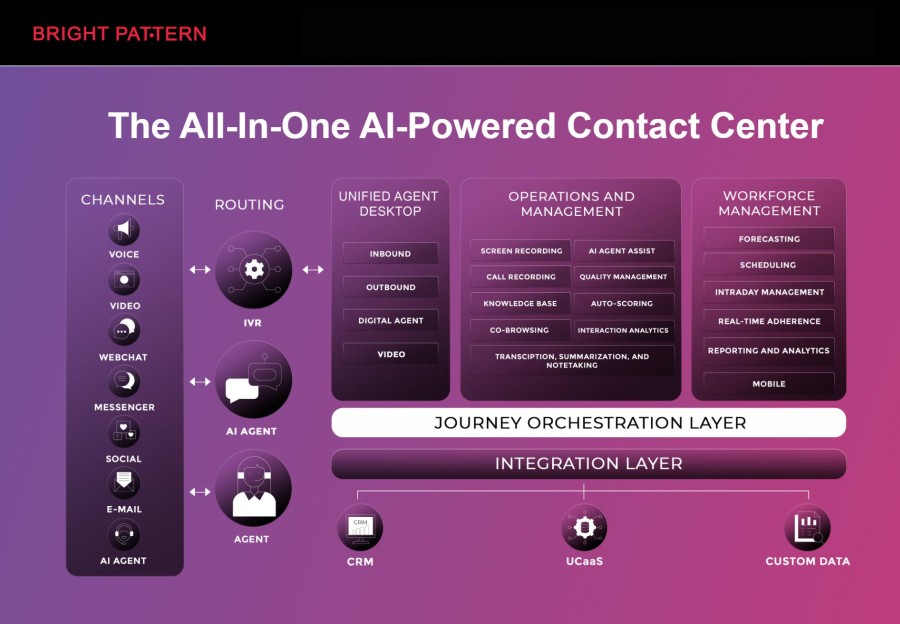
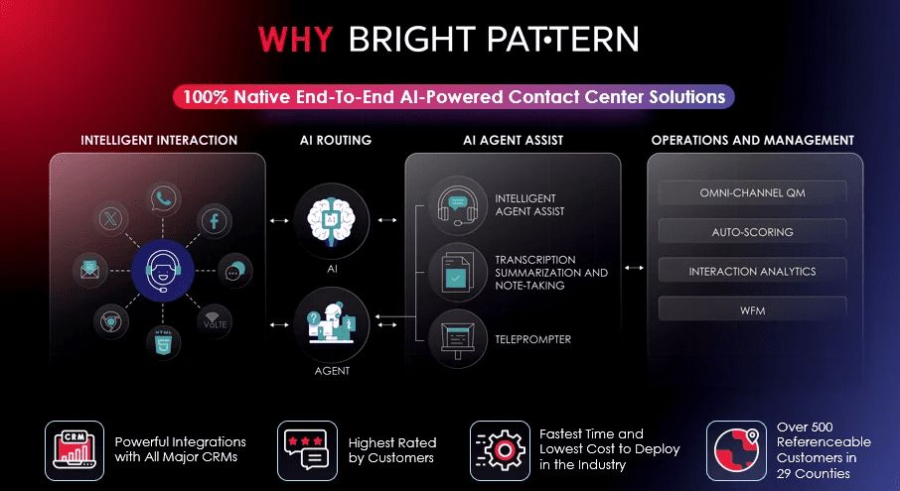
Bright Pattern stands out as one of the most advanced automated contact center solutions for businesses that want to boost efficiency, reduce agent workload, and deliver fast, consistent customer experiences. Its platform is built for speed, scalability, and simplicity, making it an ideal choice for organizations upgrading from legacy systems or adopting automation for the first time.
Bright Pattern uses AI-driven workflows, smart routing, and real-time assistance to help teams manage more conversations with less manual effort. It supports voice, chat, email, messaging apps, and self-service channels—all unified in one platform.
Key capabilities:
- AI-powered automation that streamlines repetitive tasks
- Smart routing that connects customers to the right agents immediately
- Unified agent desktop for managing all channels in one place
- Workflow tools that reduce operational bottlenecks
- Scalable cloud architecture for growing support teams
Bright Pattern’s approach helps businesses deliver faster resolutions, improve compliance, and maintain consistency across every customer touchpoint.
2. Genesys Cloud CX
Genesys offers flexible automation tools, conversational AI, and omnichannel routing to support large enterprises looking for scalable contact center automation.
3. Five9
Five9 focuses on intelligent virtual agents, AI-driven workflows, and advanced analytics to help teams manage high call volumes efficiently.
4. NICE CXone
NICE CXone provides AI automation, workforce optimization, and self-service tools to enhance customer experience and reduce operational overhead.
5. Talkdesk
Talkdesk delivers automated call handling, AI virtual agents, and modern workflows that help organizations accelerate support operations.
6. Zendesk
Zendesk enables automated ticketing, streamlined self-service, and integrated communication channels that support both small and large customer teams.
7. RingCentral Contact Center
RingCentral offers cloud-based automation, routing, and analytics designed to improve response times across multiple communication channels.
8. UJET
UJET provides modern automation tools, real-time context sharing, and intelligent call routing for a more efficient customer support process.
9. Dialpad
Dialpad uses AI transcription, automated call handling, and predictive tools to help agents manage conversations more effectively.
10. Avaya Experience Platform
Avaya supports automated workflows, digital channels, and analytics to help companies modernize and streamline their customer engagement strategies.
What Are Automated Contact Center Solutions?
Automated contact center solutionsare platforms that use technology to handle customer interactions with minimal manual intervention. Instead of relying solely on live agents, they automate repetitive tasks, guide customers through self-service, and intelligently route more complex issues to the right person.
Automation can be applied across phone, chat, email, messaging apps, and even social channels, creating a consistent, always-on customer experience.
Common capabilities include:
- Interactive Voice Response (IVR)systems that collect information and route calls automatically.
- AI chatbots and virtual agentsthat resolve routine queries via chat, messaging, or voice.
- Automated call distributionthat sends contacts to the best-skilled or next-available agent.
- Self-service knowledge basesthat let customers find answers instantly.
- Workforce management automationfor forecasting, scheduling, and performance tracking.
- Analytics and reportingthat surface insights and improvement opportunities automatically.
Key Components and Technologies Behind Automation
Modern automated contact centers are built from several complementary technologies that work together to optimize each customer interaction.
1. Intelligent IVR and Speech Technologies
Traditional IVR systems forced callers through rigid menu trees. Modern automated contact centers replace these withspeech-enabled IVRandnatural language understandingthat sound more human and feel more intuitive.
- Customers can speak in natural language instead of “press 1 for billing.”
- Systems capture intent and key data, then route efficiently.
- Simple requests, such as balance inquiries or order status, can be completed fully through self-service.
2. AI Chatbots and Virtual Agents
AI-powered virtual agentshandle a large volume of repetitive enquiries across web chat, in-app chat, and messaging channels. They can:
- Answer FAQs instantly, 24/7.
- Authenticate customers and pull relevant data from back-end systems.
- Guide users through step-by-step processes such as password resets or order updates.
- Seamlessly hand off to live agents with full context when needed.
3. Intelligent Routing and Omnichannel Orchestration
Automation is not only about bots. It is also about ensuringevery interaction reaches the right person, at the right time, on the right channel.
- Skills-based routingsends queries to agents best qualified to resolve them.
- Priority ruleshelp high-value or at-risk customers skip the queue.
- Omnichannel routingkeeps context when customers move from chat to phone or email.
4. Self-Service Knowledge Bases
A well-structured, searchableknowledge baseis a cornerstone of automation. It powers both customer-facing self-service and agent assist tools.
- Customers can solve issues themselves via articles and step-by-step guides.
- Agents can find approved answers faster, shortening handle times.
- AI can surface the most relevant content automatically during conversations.
5. Workforce Management and Quality Automation
Automation also improves internal operations and agent performance.
- Forecasting and schedulinguse historical data and AI to align staffing with demand.
- Automated quality monitoringcan evaluate interactions at scale, not just random samples.
- Performance dashboardshighlight coaching opportunities and top performers.
6. Analytics and Continuous Optimization
Every interaction generates data. Automated contact center platforms use that data to:
- Identify bottlenecks and recurring issues.
- Spot phrases or topics linked to churn or dissatisfaction.
- Test new flows, scripts, and self-service options.
- Continuously improve the overall customer journey.
Business Benefits of Automated Contact Center Solutions
When implemented thoughtfully, automation delivers benefits across customer experience, operational efficiency, and employee engagement.
1. Faster Response Times and 24/7 Availability
Automated systems do not sleep. They provide immediate responses at any hour, dramatically reducing wait times and abandonment rates.
- Customers can access support when it suits them, not just during business hours.
- High-volume periods are smoother because bots absorb a significant portion of demand.
- Queues are reserved for issues that genuinely require human expertise.
2. Lower Cost per Contact
Every customer conversation previously required live-agent time. Automation changes this equation by handling a large share of contacts at very low incremental cost.
- Routine, repetitive tasks are offloaded to bots and self-service flows.
- Agents spend more time on high-value conversations that justify human attention.
- Operational costs decrease while the contact center’s capacity increases.
3. Higher Customer Satisfaction and Loyalty
Customers value convenience, speed, and accuracy. Automated contact center solutions deliver on all three when designed with the customer journey in mind.
- Quicker answers reduce frustration and perceived effort.
- Consistent, policy-aligned responses build trust.
- Personalized interactions, powered by integrated data, feel more relevant.
4. Better Agent Experience and Reduced Burnout
Automation is not about replacing agents; it is aboutsupporting and elevating them.
- Agents no longer spend their day on the same simple questions.
- Tools surface suggested responses, customer history, and knowledge articles in real time.
- With fewer monotonous tasks, teams can focus on complex, rewarding work.
5. More Consistent Quality and Compliance
Automated workflows help standardize how policies are applied and how sensitive data is handled.
- Scripts and process flows ensure key disclosures are made consistently.
- Automated checks can flag potential compliance issues rapidly.
- Recorded and transcribed interactions make audits more efficient.
6. Richer Insights for Business Decisions
Every conversation is a voice of the customer moment. Automation makes it feasible to analyze nearly all of them, not just a small subset.
- Trends in questions and complaints highlight product or process gaps.
- Sentiment analysis reveals how customers feel about changes and campaigns.
- Decision-makers gain a direct view into customer needs and opportunities.
Traditional vs. Automated Contact Centers
The table below highlights how automated contact center solutions change core aspects of operations.
Aspect | Traditional Contact Center | Automated Contact Center |
Availability | Limited to staffed hours | 24/7 self-service and virtual agents |
Handling Routine Queries | Primarily human agents | Bots and IVR handle the majority |
Routing | Basic rules, manual transfers | Skills-based, AI-driven routing |
Quality Monitoring | Sample-based, manual review | Automated, large-scale evaluation |
Scalability | Add agents to add capacity | Scale interactions with software and AI |
Customer Experience | Inconsistent, agent-dependent | More consistent and personalized |
Common Use Cases for Automated Contact Centers
Automation can create value across a wide range of industries and functions.
Customer Service and Support
- Account balance, order status, and shipping updates.
- Billing queries and payment confirmations.
- Password resets and access troubleshooting.
- Appointment scheduling and rescheduling.
Sales and Revenue Generation
- Pre-qualifying leads before connecting them to sales agents.
- Providing product information and recommendations.
- Guiding customers through checkout or upgrade flows.
Retention and Collections
- Proactive notifications about upcoming renewals or expirations.
- Automated payment reminders with self-service payment options.
- Win-back campaigns that offer tailored incentives via automated outreach.
Internal Service Desks
Automation is equally valuable foremployee-facing contact centers, such as IT and HR help desks.
- Handling common IT tickets like software access or password resets.
- Answering policy questions and HR FAQs.
- Guiding employees through onboarding and benefits enrollment tasks.
How to Implement Automated Contact Center Solutions Successfully
Successful automation is less about technology alone and more about thoughtful design and change management. The steps below provide a practical roadmap.
1. Define Clear Objectives
Start with the business outcomes you want, such as:
- Reducing average handle time or queue length.
- Improving first-contact resolution and customer satisfaction scores.
- Deflecting a percentage of contacts to self-service.
- Supporting 24/7 coverage without increasing headcount.
2. Map Customer Journeys and Identify Quick Wins
Analyze your most common interaction types and journeys.
- List your top reasons for contact by volume.
- Highlight those that are rule-based and repetitive.
- Target these for initial automation to deliver quick, visible results.
3. Choose the Right Technology Stack
Depending on your size and complexity, you may opt for a single integrated platform or a combination of best-of-breed tools. Look for solutions that offer:
- Robust IVR and conversational AI capabilities.
- Flexible routing and omnichannel support.
- Integration options for CRM, ticketing, and core systems.
- Comprehensive analytics, including real-time dashboards and historical reporting.
4. Design Experiences with the Customer in Mind
Automation should feel helpful, not obstructive. Design flows that:
- Use natural, friendly language.
- Offer clear options and guidance.
- Make it easy to reach a human agent when needed.
- Avoid unnecessary steps or data entry.
5. Involve Agents Early and Often
Your agents understand customer questions and pain points better than anyone. Involving them in design and testing delivers better outcomes.
- Gather feedback on which tasks they would most like to automate.
- Capture best-practice responses to feed knowledge bases and bots.
- Train agents on how to work alongside automation and use new tools effectively.
6. Launch Iteratively and Optimize Continuously
Instead of waiting for a massive, all-at-once rollout, launch automation in phases.
- Start with a limited set of use cases.
- Monitor performance and customer feedback closely.
- Refine flows, content, and routing based on real-world data.
- Expand to additional scenarios once you have validated success.
Best Practices for Maximizing Value
To get the most from automated contact center solutions, keep these best practices in mind.
Keep Humans in the Loop
- Provide an easy, visible option for customers to connect with agents.
- Share full interaction history with agents to avoid repetition.
- Use agent feedback and performance data to train and improve AI models.
Design for Personalization
- Connect automation to your CRM and customer database.
- Reference customer details where appropriate, such as recent orders or previous cases.
- Use business rules to adapt flows based on customer segment or value.
Prioritize Transparency and Trust
- Let customers know when they are interacting with an automated system.
- Explain how their data is used and protected.
- Provide clear confirmations and records of key actions, such as payments or changes to accounts.
Measure What Matters
Success should be quantified. Align performance metrics with your original objectives and track them consistently.
Key Metrics for Automated Contact Centers
The following metrics help you evaluate and refine your automation strategy.
Metric | What It Measures | Why It Matters |
Self-Service Containment Rate | Percentage of interactions fully resolved by automation without agent involvement | Indicates how effective your IVR, bots, and knowledge base are at resolving issues end-to-end |
First-Contact Resolution (FCR) | How often customer issues are solved in a single interaction | Higher FCR is linked to higher satisfaction and lower operational cost |
Average Handle Time (AHT) | Time agents spend handling interactions, including talk and after-call work | Well-designed automation should reduce AHT by improving data capture and guidance |
Customer Satisfaction (CSAT) | Customer rating of their experience, usually via survey | Shows how customers feel about automated and assisted interactions |
Net Promoter Score (NPS) | Likelihood that customers will recommend your brand | Reflects overall loyalty and the combined impact of all touchpoints |
Cost per Contact | Total cost divided by number of interactions handled | Demonstrates efficiency gains from automation at scale |
Common Myths About Automated Contact Centers
As automation grows, a few persistent myths can slow adoption. Clarifying them helps teams move forward confidently.
Myth 1: Automation Replaces Human Agents
In reality, leading organizations use automation toaugmentagents, not replace them.
- Bots handle routine tasks; humans handle complex, emotional, or high-value interactions.
- Agent assist tools make humans more effective and supported.
- Roles evolve toward problem-solving, relationship-building, and specialized expertise.
Myth 2: Customers Do Not Like Automated Systems
Customers dislikepoorly designedsystems. When automation is clear, fast, and helpful, customers often prefer it for simple tasks.
- Self-service is popular when it saves time.
- Many users are comfortable with chatbots and voice assistants in daily life.
- Offering a choice of automated or human support accommodates different preferences.
Myth 3: Automation Is Only for Large Enterprises
While large contact centers were early adopters, today’s cloud-based solutions make automation accessible to businesses of all sizes.
- Smaller teams can start with a focused set of use cases.
- Pay-as-you-go models allow gradual scaling.
- The same tools that empower big brands can be tailored to growing organizations.
How to Choose the Right Automated Contact Center Solution
Selecting the right platform is critical to realizing the full benefits of automation. Consider these dimensions during evaluation.
Functional Capabilities
- Does it support all channels your customers use today and may use tomorrow?
- Are the IVR and chatbot capabilities flexible and easy to update?
- Does it offer strong routing, reporting, workforce management, and quality features?
Integration and Data
- Can it connect smoothly with your CRM, ticketing, and core business systems?
- Does it allow you to leverage existing customer and product data for personalization?
- Is data accessible for analytics and business intelligence tools?
Ease of Use and Administration
- Can non-technical users design and update flows with low effort?
- Are dashboards and reports straightforward to configure and interpret?
- Is there built-in support for testing and optimization?
Scalability and Reliability
- Can the platform handle peak volumes without degrading performance?
- Does it offer options to scale across regions and business units?
- What levels of uptime and support are provided?
Security and Compliance
- Does it align with your industry’s regulatory requirements?
- How does it protect sensitive customer data?
- Are audit trails and access controls robust and configurable?
The Future of Automated Contact Centers
Automation is evolving rapidly, opening up new possibilities for differentiated customer experiences.
Generative AI for Smarter Conversations
Generative AI is enhancing virtual agents and agent assist tools. It can summarize interactions, draft responses, and adapt language to customer tone, all while following business rules and guidelines.
Hyper-Personalized Journeys
As data integration improves, automated contact centers will offer increasingly personalized experiences.
- Proactive outreach tailored to customer behavior and preferences.
- Dynamically adjusted flows based on past interactions.
- Recommendations that feel uniquely relevant to each individual.
Tighter Alignment with the Entire Customer Lifecycle
Contact centers are becoming strategic hubs for customer intelligence and engagement. Insights gathered via automated interactions will increasingly inform product development, marketing, and overall business strategy.
Conclusion: Turning Your Contact Center into a Strategic Advantage
Automated contact center solutions transform support from a cost center into a growth engine. By combining AI, intelligent routing, and data-driven optimization, you can deliver faster, more satisfying experiences at scale while empowering your agents to do their best work.
Organizations that embrace thoughtful automation are positioning themselves for stronger loyalty, better margins, and a more resilient, future-ready customer experience. The next move is yours: identify the journeys where automation can shine, involve your teams, and start building the contact center your customers will love.
